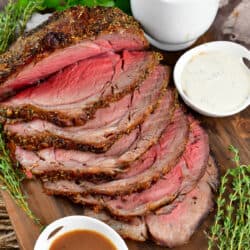
Prime Rib Recipe
Make this perfectly tender, juicy prime rib, aka standing rib roast, with a crisp herb crust using an overnight salt method and a simple slow-roast technique. This foolproof prime rib recipe delivers restaurant-quality results with minimal stress, even for beginners. This steak shines on its own but you can also serve it with red wine Au Jus or horseradish sauce.
Servings: 8 (6-8 servings)
Calories: 814kcal
Ingredients
Prime Rib:
- 4.5 lbs prime rib roast
- 3-4 tbsp coarse salt depending on the size of the meat
Seasoning:
- 3-4 tbsp olive oil
- 8-10 garlic cloves pressed
- 2 tsp dried crushed rosemary
- 2 tsp dried thyme
- 1 tsp fresh cracked black pepper
- 1 tsp garlic powder
Instructions
Prepare Prime Rib:
- Separate the ribs from the meat. (You can ask the butcher to separate the ribs from the meat and tie the roast or you can do it yourself at home.)
- To Separate The Rib Bone:Stand the prime rib on the cutting board, rib bone up.Using a pairing knife, carefully slice along the rib bone to separate the bone from the roast. Try to get as close to the bone as you can and follow the curve of the bone!TIP: don’t discard the rib but add it to the bottom of the roasting pan and hopefully it will add some juices to the pan drippings.
- If you have a large fat cap, you can cut some of it off, about half of it, but not all. (You need some fat to keep the prime rib tender and juicy.) Score the leftover fat cap on top by slicing it in a crisscross pattern.
- Generously rub the meat all over with coarse salt. Make sure to get in between the cuts in fat and on the sides.
- Use kitchen twine to tie the prime rib. Slide the twine under the roast and then pull it tight together, cross and make another loop around the prime rib about an inch away. Depending on the size of your prime rib, you would need to tie in 3-5 places, about an inch apart.
- Place it on the plate, cover tightly with plastic wrap and aluminum foil. Refrigerate overnight or up to 18 hours.
Cooking Prime Rib:
- Make sure to pull the meat out of the refrigerator 2-3 hours before cooking and let it get to room temperature.
- Preheat oven to 500°F and place a wire rack inside a roasting pan. (You can line the bottom of the roasting pan to easier catch the drippings and to make clean up a breeze.)
- Since you already salted the meat the day before, you don’t need to add more salt. So combine pressed garlic, olive oil, dried herbs, black pepper, and garlic powder in a bowl and mix.
- Place the salted prime rib into a rimmed baking sheet and pour the wet rub over it. Rub the whole piece of meat with the seasoning mix all over, on all the sides. Try to get it as even as possible.
- Transfer prime rib into the prepared roasting pan. Make sure to use the leave-in thermometer to track the temperature of the meat! Insert the probe into the middle of the meat to track the temperature of the very center. (If you don't have one, you will need to take the prime rib out of the oven to check the temperature.)
- Place the roasting pan into the oven and cook at 500°F for 15-20 minutes. Lower the temperature to 250°F and cook until the roast reaches your desired temperature.
- Let it cook until the temperature reaches 120°F for medium-rare or 130°F to be closer to medium. (Remember that the temperature of the meat keeps going up about 5° while it's resting.)
- My 4.5 lb. roast took about 2 hours and 15 minutes to get to the medium-rare temperature. It's hard to give an exact time because thickness of roasts does vary and therefore, relying on the time in not the best indicator of doneness. Thermometer is the best way to tell if your meat is done.
- TIP: If you do not have a leave-in thermometer, take the prime rib out of the oven to measure internal temperature and close the oven. This will prevent temperature drops in the oven.
Carving Prime Rib:
- Once the meat reached the temperature, take it out of the oven and place it on the cutting board. Cut the twine off the prime rib. Tent it with aluminum foil loosely and let it rest for about 20 minutes.
- Slice the prime rib using a long, sharp knife against the grain, into steaks that are about 1/2 an inch thick. You can carve a little thicker or a little thinner depending on the sides you serve…and how much you love your guests.
Video
Nutrition
Calories: 814kcal | Carbohydrates: 2g | Protein: 35g | Fat: 73g | Saturated Fat: 29g | Polyunsaturated Fat: 3g | Monounsaturated Fat: 33g | Cholesterol: 154mg | Sodium: 2731mg | Potassium: 586mg | Fiber: 0.3g | Sugar: 0.04g | Vitamin A: 12IU | Vitamin C: 1mg | Calcium: 33mg | Iron: 4mg